
IoT Platform | Yun-IOT
YunIOT IoT Cloud Platform is one of the few private-deployment products in China covering IoT cloud service capabilities comparable to BAT and Huawei. It provides reliable, secure, and stable terminal access, protocol adaptation, message routing, data storage and analysis, and application enablement — making it the professional choice for enterprises building IoT middle platforms and developing IoT applications.
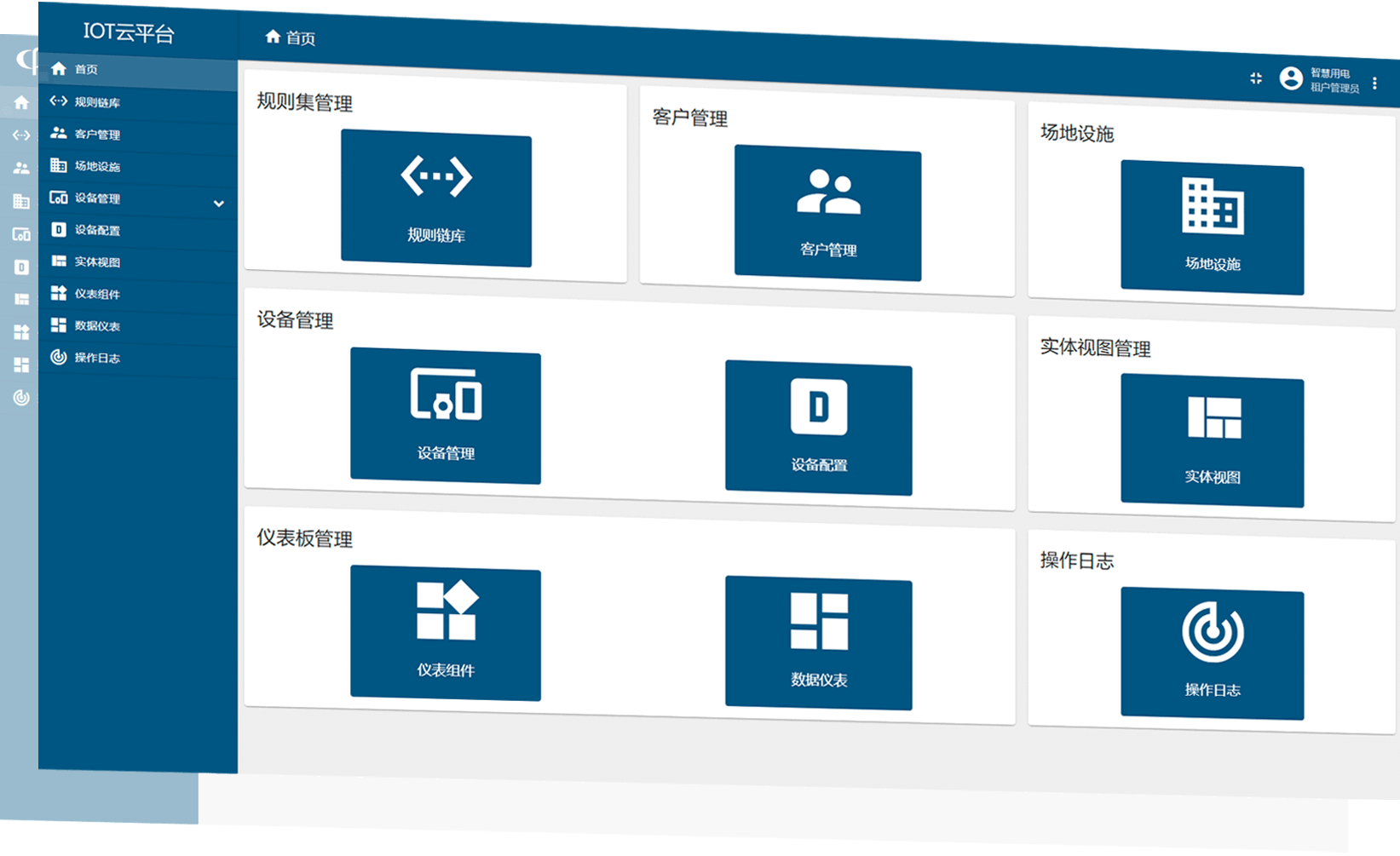

Product Advantages

Standard IoT Protocols
(MQTT, CoAP and HTTP) Enable device connectivity with scalability, fault tolerance, and performance so you never lose data.

Device & Asset Management
Use rich server-side APIs to securely provision, monitor, and control your IoT entities. Define relationships between devices, assets, customers, or any other entities.

Data Collection & Visualization
Collect and store telemetry data in a scalable and fault-tolerant way. Visualize your data with built-in or custom widgets and flexible dashboards. Share dashboards with your customers.

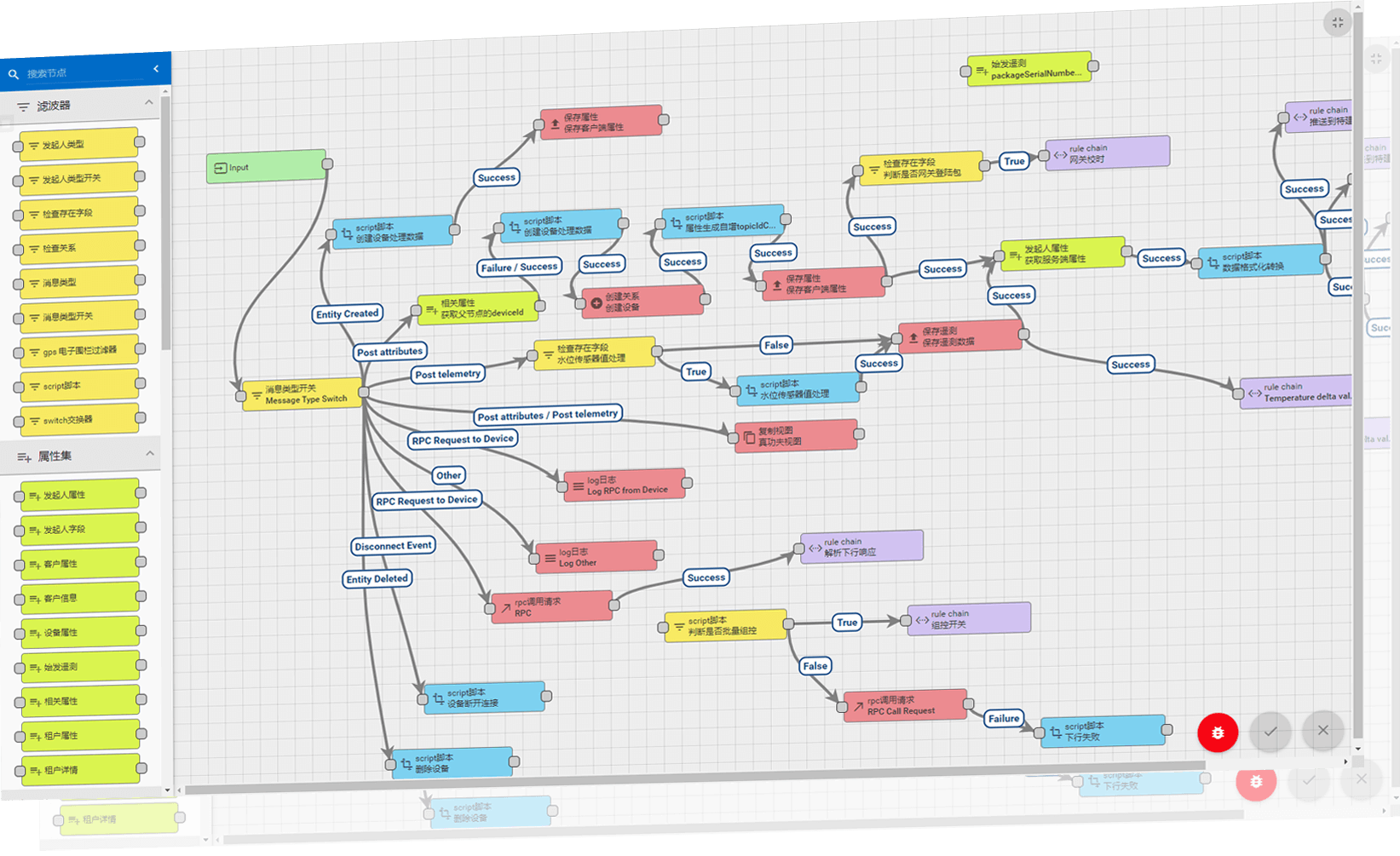
Rule Chain Engine
Process incoming device data with drag-and-drop flexible rule chain configuration for filtering, processing, and analysis to generate the value you want, or forward data to external systems or trigger alerts with custom logic.

Fault Tolerance & Security
Supports transport encryption for MQTT and HTTP(s) protocols, device authentication, and device credential management. Automatically detects node failures and can replace failed nodes without downtime.

Customization & Integration
Extend default platform functionality with customizable rule chains, widgets, and transports. Beyond MQTT, CoAP, and HTTP support, users can implement their own transports or customize existing protocol behavior.
Alerts & Notifications
Provides functionality to create and manage alerts related to entities: devices, assets, customers, etc. Enables real-time alert monitoring and alert propagation to related entity hierarchies. Raises alerts for device disconnection or inactivity events.
High Performance & Concurrency
A single instance can continuously process 20,000+ devices and 30,000+ data messages per second, averaging 2 million messages per minute. Easily receive, store, and visualize over 100 million messages from your devices.
Product Comparison
Device Access
Need to build infrastructure, coordinate embedded developers with cloud developers. High development workload, low efficiency.
Performance
Self-implemented scalability architecture, extremely difficult to schedule servers and load balancing at the device granularity level.
Security
Requires additional development and deployment of various security measures. Ensuring device data security is a major challenge.
Ease of Use
Need to purchase servers and build load-balanced distributed architecture. Requires significant manpower and resources to develop a complete IoT system of "access + computing + storage".
Device Access
Provides device-side SDK for fast cloud connectivity with high efficiency. Supports global device access, heterogeneous network access, multi-environment access, and multi-protocol access.
Performance
Million-level device persistent connection capability, million-level concurrent processing, horizontally scalable architecture.
Security
Provides multi-layer protection for device data security. Device authentication ensures device security and uniqueness. Transport encryption ensures data integrity.
Ease of Use
One-stop device management with real-time device status monitoring. Build complex IoT applications quickly, flexibly, and easily.
Technical Concepts
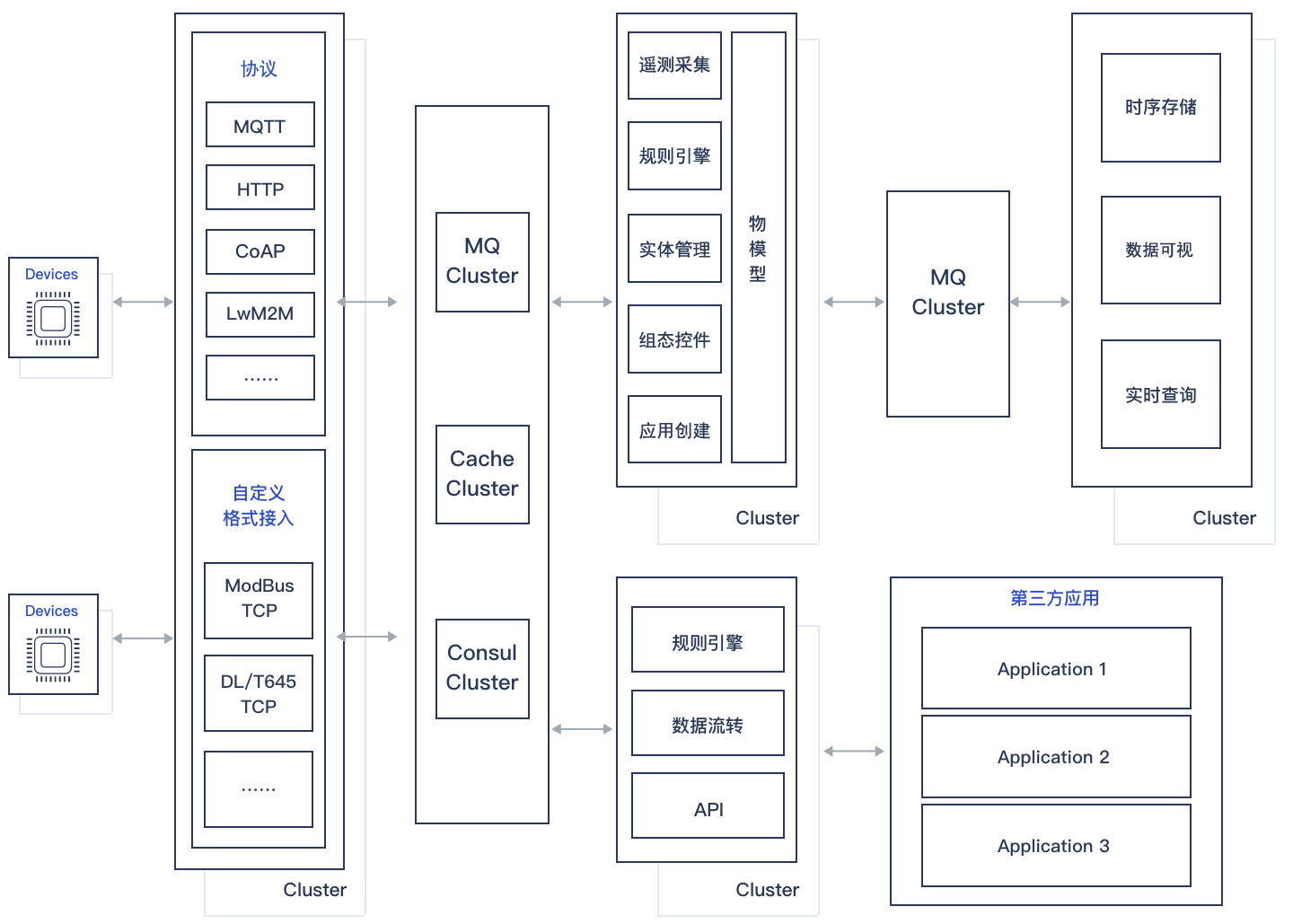
Technical Architecture
IoT is essentially a collection of IoT microservices using a distributed architecture. All application and service components have no single point of risk. Can scale on demand for different business scenarios. Enterprises don't need to worry about high concurrency, stability, and other technical challenges.
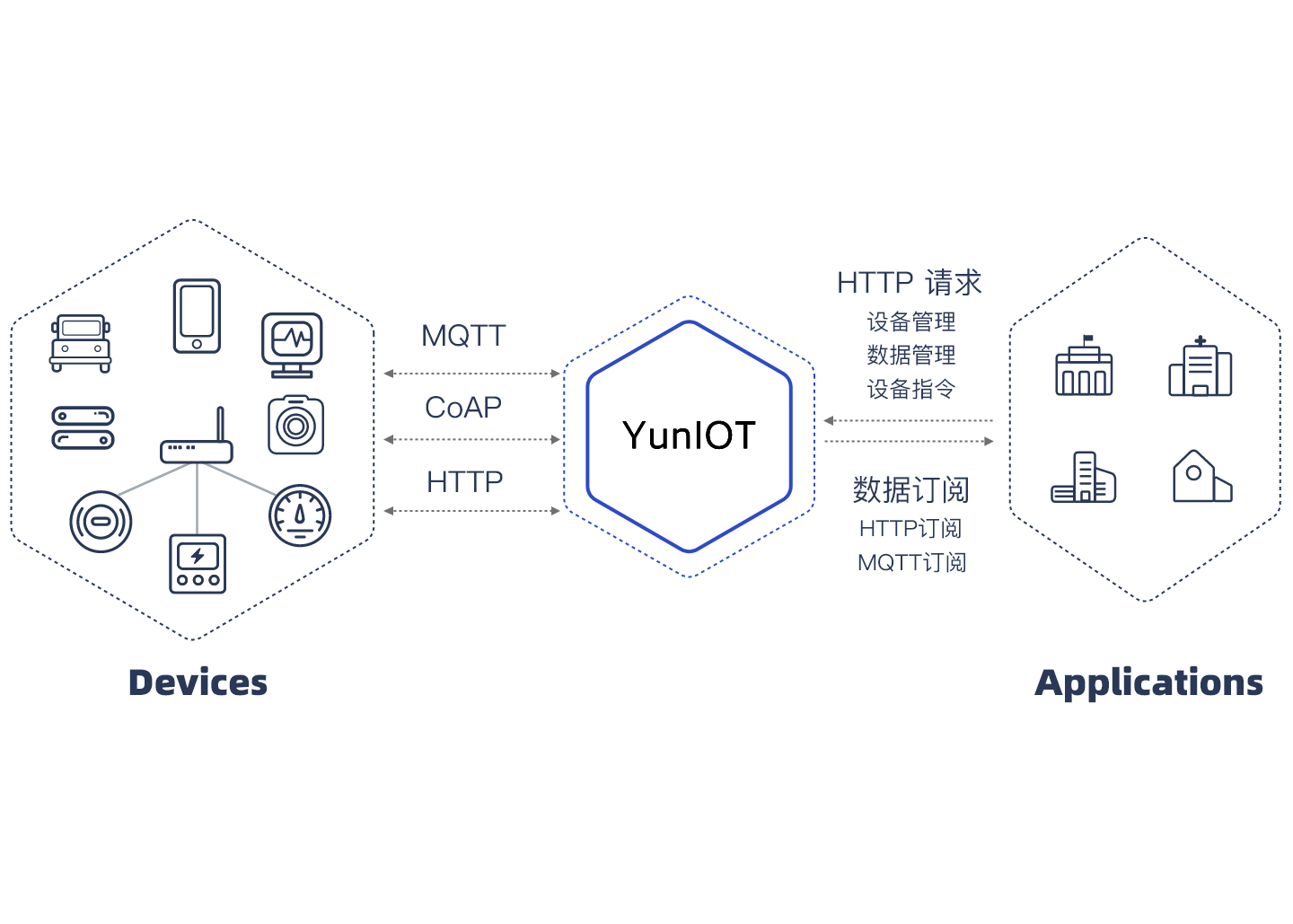
Access & Integration
IoT's southbound capability lies in diverse heterogeneous device access, while northbound capability lies in supporting various business systems and application scenarios. Bridging the two decouples devices from business, making standardized application systems possible.
Usage Process
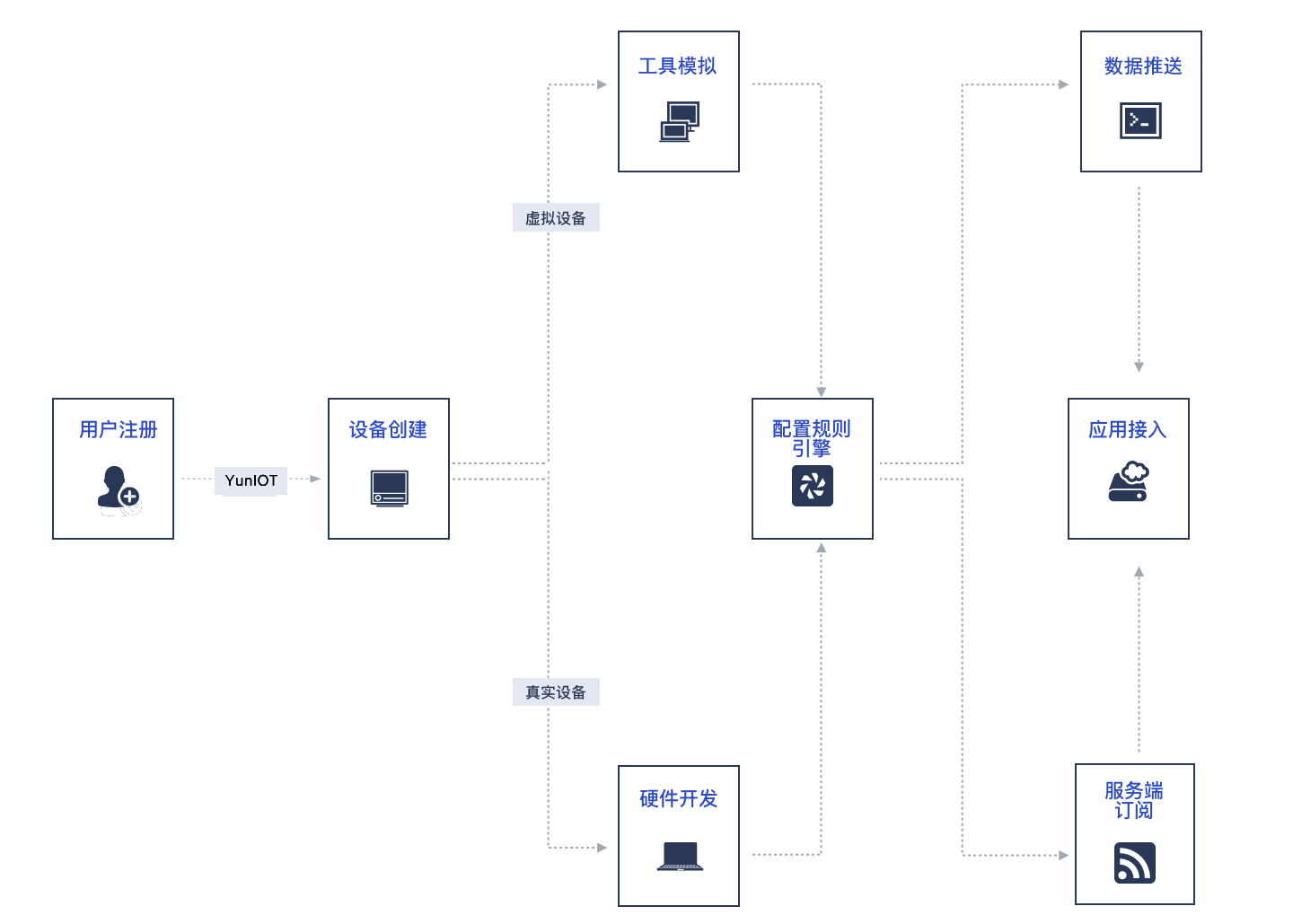
Users simply log into the visual console and write minimal code to quickly achieve device cloud connectivity and application development. Based on IoT's one-stop standard access capabilities, enterprises can significantly reduce technical investment and even develop an ecosystem of product supply and outsourced R&D around IoT.
Feature Showcase
- Telemetry
- Rule Engine
- Entity Mgmt
- Widgets
- App Creation

Telemetry Acquisition
- Collect data from devices using MQTT, CoAP, or HTTP protocols
- Store time-series data in Cassandra (efficient, scalable, and fault-tolerant NoSQL database)
- Query latest time-series data values or all data within a specified time interval
- Subscribe to data updates using Websockets (for visualization or real-time analysis)
- Visualize time-series data using configurable and highly customizable widgets and dashboards
- Filter and analyze data using flexible rule engine, generate alerts based on collected data
- Forward data to external systems using rule nodes (e.g., Kafka or RabbitMQ rule nodes)

Rule Engine
- Manage things and process the data they generate, involving data storage, flow, and usage.
- Analyze and compute incoming telemetry or attribute data before saving to the database.
- Execute actions based on defined conditions, create/update/clear alerts. Trigger actions on device lifecycle events, e.g., create alert if device goes online/offline.
- Load additional data needed for processing. For example: device load temperature threshold defined in device customer or tenant attributes.
- Trigger REST API calls to external systems, or make RPC calls to devices based on conditions.
- Send emails on complex events, using attributes from other entities in email templates.
- Integrate with external systems or services (e.g., Kafka, Spark, AWS services) such as pushing data to third parties.

Entity Management
- Tenant - You can think of a tenant as a separate business entity: an individual or organization that owns or produces devices and assets. Tenants may have multiple tenant administrator users and millions of customers.
- Customer - A customer is also a separate business entity: an individual or organization that purchases or uses tenant devices and/or assets. Customers may have multiple users and millions of devices and/or assets.
- User - Users can browse dashboards and manage entities.
- Device - Basic IoT entity that may produce telemetry data and process RPC commands. Examples: sensors, actuators, switches.
- Asset - Abstract IoT entity that can be related to other devices and assets. Examples: factory, site, parking lot, store.
- Dashboard Widget - Visualization of IoT data and ability to control specific devices through the user interface.

Configuration Control
- Digital and analog gauges for real-time value visualization.
- Highly customizable bar and line charts for displaying historical data and sliding window data points.
- Map widgets for tracking IoT device movement and latest location on Google or OpenStreet maps.
- GPIO control widgets allowing GPIO toggle commands to be sent to devices.
- Card widgets to enhance dashboards with flexible HTML labels based on IoT device static content or latest telemetry values.

Application Creation
- Based on rich and easy-to-use widget types, even non-developers can create ideal application displays through online drag-and-drop editing.
- Developers can write native JS, HTML, CSS code through the online IDE for highly customized implementations of your needs.
- Each web visual interface can contain multiple widgets that can bind data with any entity object and render data.
- After creating an application visual interface, you can make it public and share it anywhere as an online link, or integrate it into your application project.
Application Scenarios
Thanks to YunIOT's technical advantages and rich features, it is widely applied across various scenarios.

City Management
Unified integration and monitoring of city air temperature and humidity, noise, sewage water level, soil moisture, temperature, conductivity, salinity, NPK content, pH value, etc.

Ecological Infrared Monitoring
Unified monitoring of soil NPK, temperature, humidity, salinity, conductivity, PM1, PM2.5, PM10 sensors.

Smart Parking
Parking space information, occupancy status, vehicle parking duration, target area vehicle flow statistics.

Smart Restaurant
Safe electricity monitoring, fire alarm, noise, air temperature and humidity, etc.

City Safety - Underground Monitoring
Gas concentration analysis, VOC, hydrogen sulfide and other gas monitoring.

City Safety - Building Monitoring
Target structure tilt angle, target structure crack values, etc.